 United States
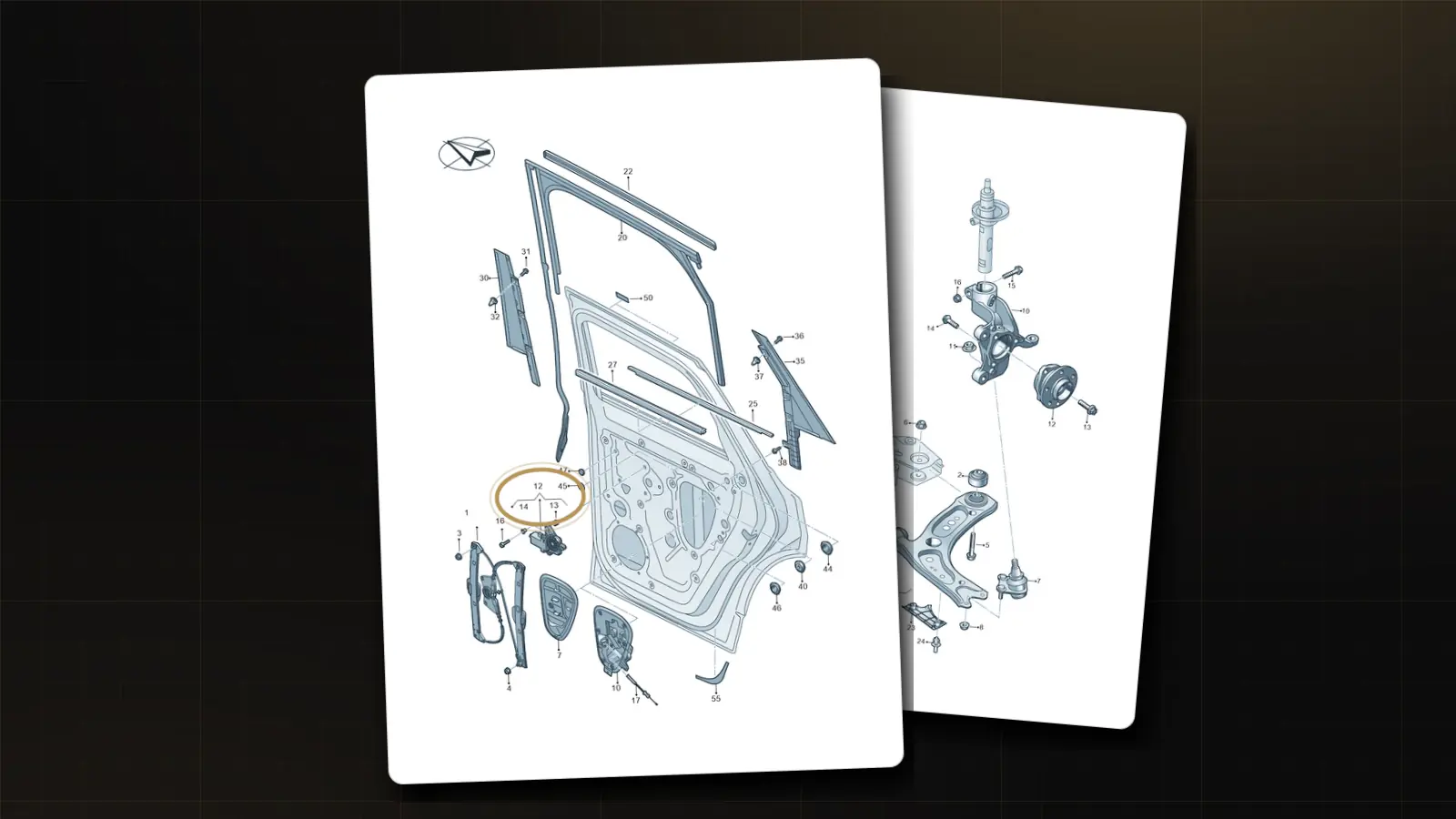
Factory exploded diagrams are the most reliable way to identify a part — dealers and mechanics have used them for decades. They also have their own visual language, and once you know it, any drawing from any VAG brand reads the same way. This guide walks through the conventions using real drawings from oemdiagrams.com, our free catalogue of factory diagrams for Volkswagen, Audi, SEAT, Škoda and Porsche.
What an exploded view actually shows
An exploded view takes an assembly — a door, a front axle, a bumper — and pulls it apart along its assembly axes. Parts are drawn in the order and direction they fit together, so a bolt floats above the hole it threads into, and a trim strip hovers over the panel it clips onto. The long dash-dot lines you see are those axes: follow one and you know exactly where and in which direction a part mounts.
Callout numbers are positions, not part numbers
Every number on the drawing — 1, 2, 3… — is a position in that diagram's parts list, not a part number itself. The list alongside the diagram maps each position to the genuine OEM part number, its name, and the vehicles it fits. Two things follow from that:
- The same position number can appear at several places on the drawing. That is one part number used more than once — clips and screws are the usual case.
- Position numbers restart on every diagram. Position 12 on a door drawing has nothing to do with position 12 on a suspension drawing.
On oemdiagrams.com the list and the drawing are linked live: hover a number and the part lights up on the drawing; click it and you land on the part page with its genuine number, name, fitment and any replacement number.
Leader lines, brackets and small hardware
Left: a set bracket — position 12 covers the items under the brace. Right: leader lines and fixings — part 30 with its screw (31) and fastener (32).
Three conventions do most of the work:
- Leader lines connect a number to its part. When parts sit close together, the arrowhead — not the number's position — tells you which one is meant.
- Set brackets (the horizontal brace under a number) mean that position is supplied as an assembly which includes the items under the bracket. In the drawing above, position 12 comes as a set including items 14 and 13. If you only need the small pieces, check whether they carry their own position — if they do, they are usually available separately.
- Small hardware gets its own numbers. Bolts, nuts, clips, grommets and caps are real positions with real part numbers. If your job needs single-use fasteners, they are on the drawing — order them with the main part instead of discovering the shortage mid-job.
One drawing, many cars
Factory drawings are often shared across model years and trims, so not every numbered part on a drawing fits every car. The parts list — not the picture — decides fitment. This is the single most common way people order the wrong part from a diagram.
The catalogue handles this for you: pick your exact vehicle on oemdiagrams.com (or find it by VIN) and the positions that don't apply to your car are filtered out. If a part exists in left and right versions, our guide to VAG part number structure shows how to tell the sides apart.
The same drawings on WW Spares
Every genuine VAG part in our store now shows its factory drawing right on the product page — with the part you are viewing ringed in gold, a vehicle selector, and the full list of cars it fits. We wrote about the whole integration in our launch announcement.
So next time you need a part: open the drawing, find the position, check the list. Five minutes with the diagram beats a week waiting on a return — and it is all free to browse.